Last updated October 15, 2026
How to Hire a ADU Contractor in Houston: A Step-by-Step Guide
The contractor you interview and the workers who show up on day one are often two completely different groups of people – and in Texas, where subcontracting chains have no mandatory disclosure law, you can legally be surprised by who’s walking through your gate. Most Houston homeowners spend weeks comparing floor plans and finish samples, then sign a contract without ever asking the one question that determines whether the next twelve months feel safe or stressful: exactly who will be on my property, and can you prove it? This guide walks you through the full hiring process for an ADU contractor in Houston, with a hard focus on the 72-hour window between signing and first arrival – because that’s where the real risk lives. You’ll learn what documents to demand, how to verify a license in minutes, how to structure payments so you’re never over-exposed, and how to tell a straight answer from a dodge.
Quick Answer
To hire an ADU contractor in Houston, verify their Texas license through the TDLR lookup tool, demand a written price lock before signing, request their subcontractor list and lien waiver policy, and ask a direct question: “Will your employees or subs be on my property, and will I see ID at the door?” Expect a properly permitted detached ADU in Houston to run $180,000 – $320,000 before site work, and expect a legitimate contractor to answer every question on this page without hesitation.
Table of Contents
- Step 1: Define Your ADU Scope Before You Call Anyone
- Step 2: Verify the Texas License (Three Minutes, No Excuses)
- Step 3: Request the Five Documents That Separate Pros from Gambles
- Step 4: Ask the Crew-Verification Question Most Homeowners Never Think to Ask
- Step 5: Compare Bids the Right Way – Apples to Apples, Not Hope to Hope
- Step 6: Structure a Payment Schedule That Protects You at Every Milestone
- Step 7: Read the Warranty Language Like a Contract Attorney
- Step 8: Prepare Your Property for the First Day (and the First Crew)
Step 1: Define Your ADU Scope Before You Call Anyone
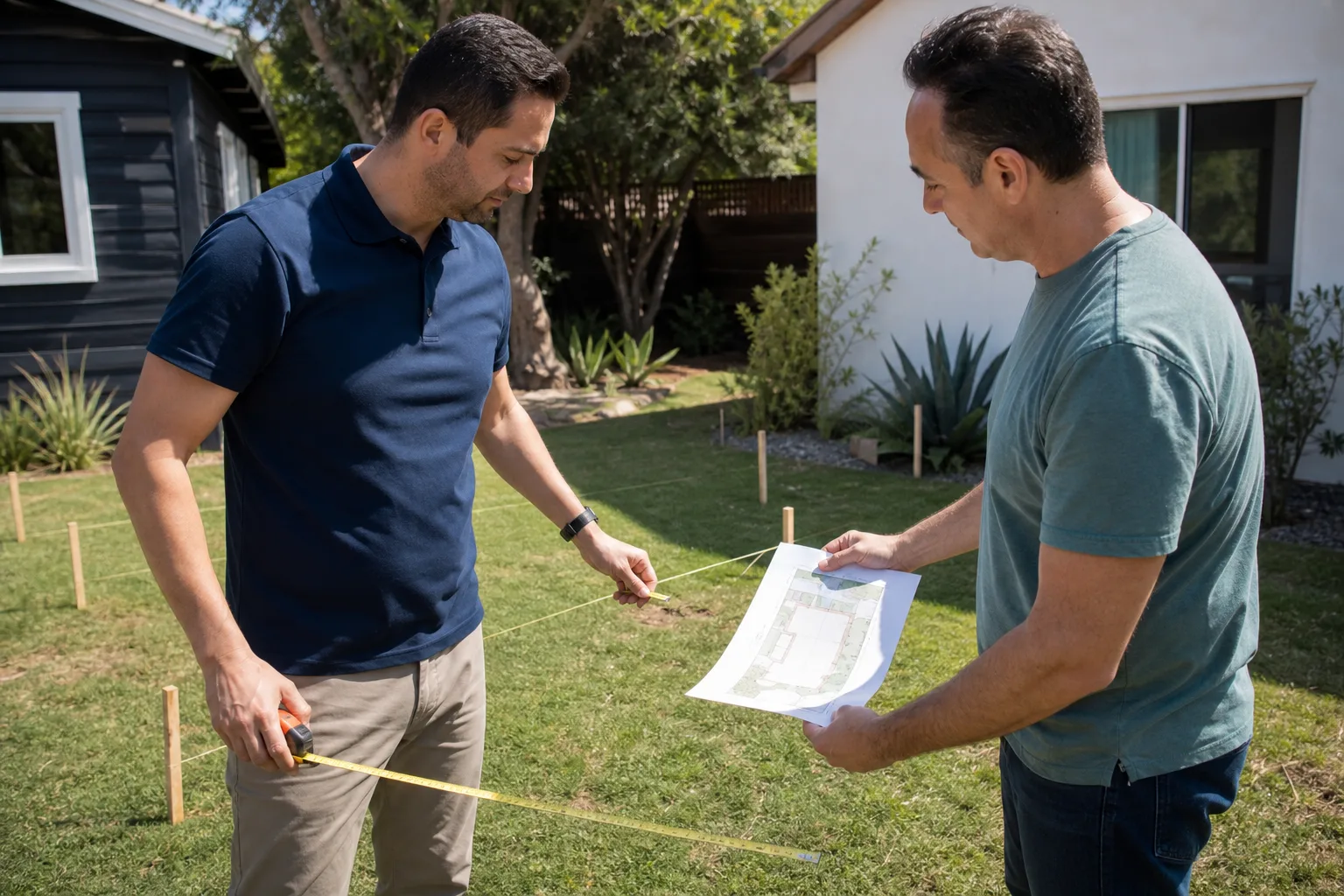
You can’t get an honest price until you can describe what you want in a way that lets a builder quote apples to apples. That doesn’t mean you need architectural drawings on day one. It means you need to answer four questions before you pick up the phone.
First, what type of ADU are you building? Houston homeowners typically choose between a detached backyard unit (new foundation, new utilities, new everything), a garage conversion (cheaper because the shell exists, but often constrained by existing slab condition and access), or an attached addition (shares a wall and roofline with the main house). Each has different permitting paths, different foundation requirements, and wildly different cost profiles.
Second, what’s the use case? A rental unit generating income has different soundproofing, separate-metering, and egress requirements than a mother-in-law suite for family. Houston’s zoning code treats these differently, and so will your contractor’s pricing.
Third, what’s your actual budget ceiling – not your hope, your ceiling? Houston’s ADU market in 2026 is not a bargain market. Between concrete costs, post-Harvey elevation considerations in some flood zones, and labor rates that have climbed steadily since 2020, you should plan for $180,000 – $320,000 for a typical 600 – 900 square foot detached unit before site work, permits, or utility connections. A garage conversion runs $90,000 – $160,000. A room addition lands between those depending on the foundation work required. If someone quotes you $60,000 for a 700-square-foot detached ADU in Houston, that number isn’t a deal – it’s a warning sign that something is being left out or cut.
Fourth, what’s your timeline reality? A properly permitted detached ADU in Houston takes 8 – 14 months from contract to certificate of occupancy. Permitting alone in the city runs 6 – 16 weeks depending on whether you’re in a flood plain or historic district. Anyone promising you a completed ADU in 60 days is either skipping permits or will be walking off your job when the city red-tags it.
Step 2: Verify the Texas License (Three Minutes, No Excuses)
Here’s the hard truth about Texas: the state licenses electricians, plumbers, and HVAC techs directly, and any general contractor performing residential work over a dollar threshold must hold a license through the Texas Department of Licensing and Regulation (TDLR). That’s the step a surprising number of Houston homeowners skip because the contractor “seemed professional.” A magnetic sign on a truck and a clean website are not a license.
Verification is faster than ordering a coffee. Go to the TDLR’s online license search, type in the business name or the individual contractor’s name, and confirm three things: the license is active (not expired, not suspended), the license type actually covers residential building work, and the name on the license matches the name on your contract. If the contract says “ATX Builders LLC” but the license is under “John’s Handyman Service,” that’s not a technicality – that’s a red flag.
In our experience in Houston, the most common licensing dodge is a contractor who holds a valid license for one trade (say, electrical) and uses it to sell general contracting services far outside that scope. A licensed electrician is not automatically a licensed GC, and the city of Houston will not accept his permit application as the general contractor of record on your ADU. The permit will be in your name, which means the liability is in your name.
The verification step takes three minutes. Do it before you sign, not after. If a contractor hesitates, says “our license number is on the website” without telling you where, or insists that state licensing “doesn’t apply to this kind of project,” end the conversation. That’s not a personality quirk – that’s an evasion pattern.
Step 3: Request the Five Documents That Separate Pros from Gambles
Most ADU contractors in Houston will happily hand you a brochure and a smile. Far fewer will hand you the five documents that actually protect you. Request all five before you sign anything.
- Texas license (current, not just mentioned). You already verified this in Step 2. Now demand a physical or PDF copy.
- Certificate of insurance (COI) with you named as additional insured. A legitimate contractor’s insurer will issue this in one business day – it’s a standard request. The COI confirms general liability coverage (we recommend confirming at least $1 million in coverage for a project this size) and workers’ compensation. In Texas, workers’ comp is not required for all employers, which means if a worker is injured on your property and the contractor doesn’t carry it, you may be personally liable. Require the COI. Verify the policy is active by calling the insurer’s listed number, not a number printed on the certificate itself.
- Subcontractor list. This is the document that tells you who actually holds the tools. Your GC may be great, but if he subs the foundation to a crew he’s never met before this job, you need to know that name before they’re in your backyard. A real contractor knows his subs. If the answer is “we’ll see who’s available,” you are hiring a middleman, not a builder.
- Lien waiver policy, in writing. If a subcontractor or supplier isn’t paid, in Texas they can file a mechanic’s lien against your property – even if you paid the general contractor in full. A legitimate ADU contractor in Houston will provide a written policy showing they use partial lien waivers at each payment milestone, protecting you from paying twice. If the contractor doesn’t know what a lien waiver is, that’s the entire answer.
- Written price lock. This is different from an estimate. An estimate is an opinion. A written price lock is a commitment that the number on the page is the number you’ll pay, with clearly defined allowances for any items that genuinely can’t be known in advance (like soil conditions or hidden rot in a garage conversion). If the “free estimate” doesn’t attach to a scope of work, it’s legally meaningless. A scope of work turns a number into a contract.
We’ve reviewed hundreds of ADU contracts in Houston, and we can tell you the pattern: the documents a contractor resists providing are the ones that matter most. If the COI “isn’t ready yet” and the subcontractor list “depends on scheduling,” you’re not hiring a builder. You’re funding someone’s experiment.
Step 4: Ask the Crew-Verification Question Most Homeowners Never Think to Ask
Here’s the question that separates a safe build from a stressful one: “Will the people on my property be your employees or subs, and can I see their IDs at the door?”
Most homeowners never think to ask this. They spend hours researching the contractor’s reputation, reading reviews, checking references – and then a completely different group of people arrives on day one. In Texas, there is no mandatory law requiring a general contractor to disclose which portions of your project are subcontracted or to whom. The person you shook hands with may never set foot on your property again after the contract signing. That’s legal.
This is why we built the Threshold Verified standard at Sutton ADU Houston: every field technician is background-checked, identity-verified, uniformed, and photo-badged. Before anyone ever walks through your gate, you receive their name and photo. When they arrive, they show a photo ID badge at the door. Every time. No exceptions. That standard exists because the question “who is in my backyard?” should never be a mystery.
When you interview any ADU contractor in Houston, ask the crew-verification question directly. Then watch the reaction. A confident, organized builder answers immediately: “Here’s how we staff projects, here who leads the site, here’s who you’ll see each day.” A contractor who’s running a lead-referral shop – collecting your deposit and passing the work to whoever’s cheapest that month – will waffle. You’ll hear things like “we have a trusted network” or “everyone we work with is vetted.” Those are not answers. Those are adjectives.
Ask for a roster. Ask how you’ll know who belongs on your property and who doesn’t. If the answer can’t produce a name and a face, keep looking.
Step 5: Compare Bids the Right Way – Apples to Apples, Not Hope to Hope
You’re going to get three bids, because that’s what everyone says to do. But three bids in the ADU space are almost never for the same project, which means you’ll be comparing three different futures, not three different prices.
Here’s how to fix that. Before you collect bids, write a one-page scope summary in your own words: detached 700-square-foot ADU, one bedroom, one bath, slab foundation, mini-split HVAC, standard kitchen appliances, Hardie plank siding, 200-amp electrical service. Send that same page to all three contractors. Then force every bid to address the same line items:
- Site prep and tree removal (often missing from low bids, then billed as a change order)
- Foundation type and any soil testing (Houston’s expanding clay soils require specific foundation design in many neighborhoods, especially older ones inside the Loop)
- Permits, plan review, and city fees (a legitimate bid includes these as specific dollar lines, not TBD)
- Utility connections – water, sewer, electrical, gas if applicable (a detached ADU needs new utility runs; this is frequently omitted from “too good to be true” numbers)
- Insulation, drywall, and finishes specified by brand and model, not “builder grade”
- Exterior cladding specified (James Hardie is a common standard in Houston because it holds up to the humidity; generic “siding” is not a specification)
- Warranty terms in writing
When a bid comes back missing a category, don’t assume it’s included – assume it’s a future change order. A $180,000 bid that includes foundation, utilities, and permits is cheaper than a $140,000 bid that omits them. The day someone hands you a change order for a missing sewer line is the day you discover your “competitive bid” was fiction.
For Houston specifically, ask about elevation and flood zone awareness too. If your lot is in a 100-year or 500-year flood plain, your ADU design may require finished floor elevation adjustments. A contractor who doesn’t bring this up before you sign either doesn’t know Houston building requirements or doesn’t care. Neither is acceptable for a six-figure project.
Step 6: Structure a Payment Schedule That Protects You at Every Milestone
The single most common financial mistake Houston homeowners make on ADU projects is front-loading the contract. A contractor asks for 40% or 50% down, the homeowner pays it, and suddenly every incentive has shifted. Money is gone. Leverage is gone. Urgency is gone. The project stalls, and the homeowner is funding someone else’s prior job.
A protective payment schedule ties money to verified, completed work. Here’s a structure we recommend as a baseline for a detached ADU in Houston:
- Deposit at contract signing: 10 – 15% (covers permits, plans, mobilization)
- Foundation complete and inspected: 15 – 20%
- Framing complete and inspected: 15 – 20%
- Rough-in complete (electrical, plumbing, HVAC) and inspected: 15 – 20%
- Drywall and finishes complete: 15 – 20%
- Final inspection passed and certificate of occupancy issued: 10 – 15%
Notice the pattern: no single payment exceeds 20% of the contract, payments follow passed inspections (not contractor promises), and a meaningful retention is held until the city of Houston signs off. Any contractor who demands more than 30% down or who doesn’t want to tie payments to inspection milestones is telling you something important about how they expect the project to go.
Also ask about change orders in writing. Houston ADU projects do produce change orders – hidden conditions happen, especially in garage conversions where the existing slab may not meet current code. A fair contract says: any change order is written, priced, and signed by you before work continues. A bad contract says: changes get handled “as we go,” which is how a $200,000 project becomes $260,000 without a single piece of paper explaining why.
Step 7: Read the Warranty Language Like a Contract Attorney
“We stand behind our work.” That sentence is worth nothing. The only warranty that means anything is a written one, with a defined term, a defined scope, and a defined remedy.
Here’s what to look for. A legitimate ADU builder in Houston offers a workmanship warranty of at least one year. The language should specify: what’s covered (defects in workmanship), what’s excluded (normal wear, homeowner-caused damage, acts of God), how long the term runs (from substantial completion or final inspection date), and what the remedy is (repair, replacement, or refund).
At Sutton ADU Houston, the 365-Day Done Right Promise covers defects in workmanship for one full calendar year from project completion. If something isn’t right, Sutton makes it right. And that’s written on every project, not offered as a verbal reassurance. We also include a free second visit if a repair or element of the build fails during the coverage period – no haggling, no fee. That’s the standard we’d want if someone were building on our property.
In Houston’s climate, the warranty conversation should also address what you’re actually likely to encounter: hairline cracks in drywall from seasonal humidity swings, minor settling in the first year, condensate line issues on HVAC units. A contractor who’s built in Houston will talk openly about what’s normal and what’s a defect. A contractor who says “nothing ever goes wrong with our builds” is either lying or hasn’t built much. Neither builds confidence.
Step 8: Prepare Your Property for the First Day (and the First Crew)
The contract is signed. The deposit is paid. The permits are in. Now comes the moment this whole guide has been building toward: the first day a crew arrives at your Houston property.
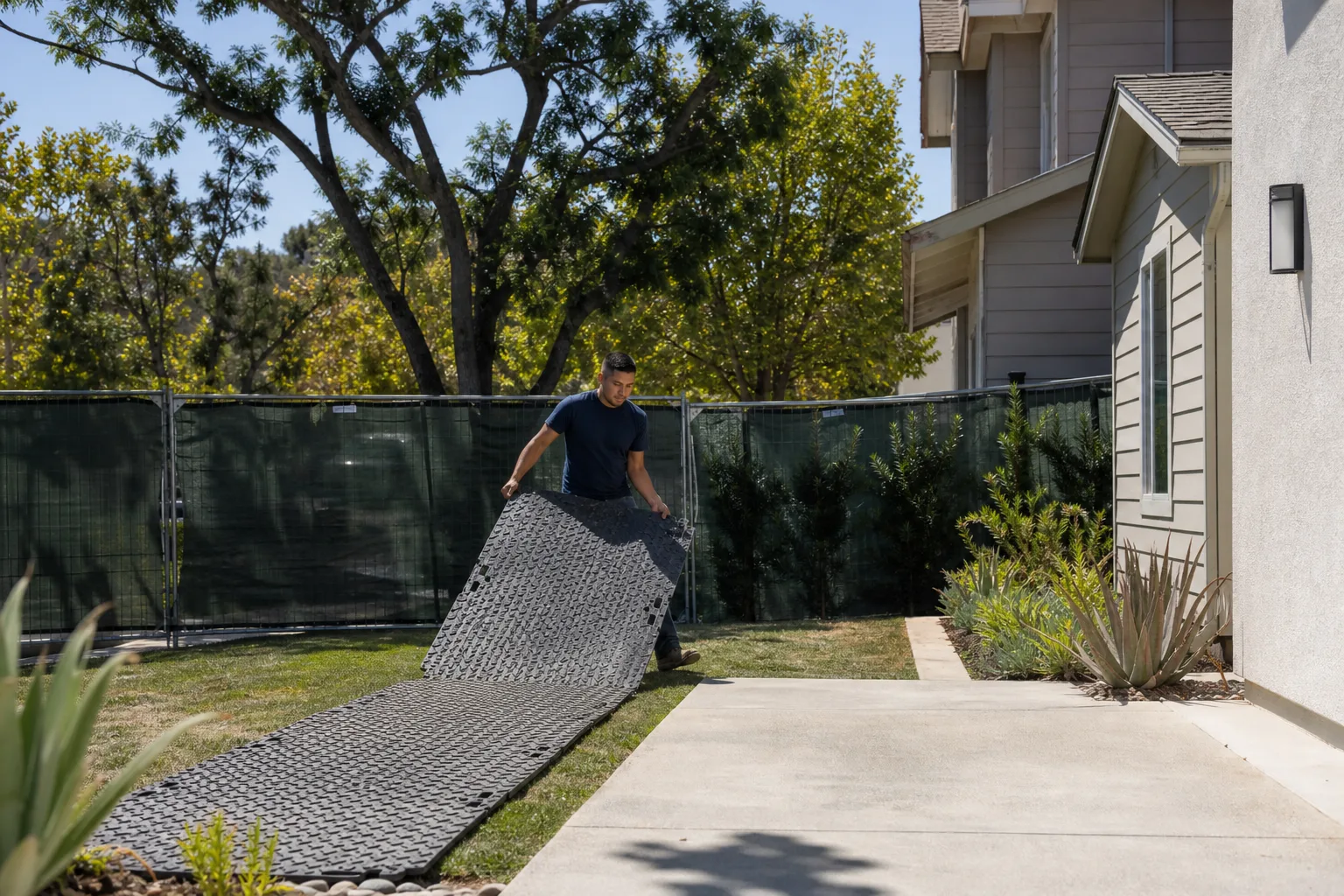
You prepare for this moment before it happens. Walk your lot and identify where materials will be staged – in Houston, that means planning for rain, because a spring downpour can turn an unplanned staging area into a mud pit that delays your foundation pour by a week. Confirm where the portable toilet will sit (yes, this is a required conversation – your crew needs facilities, and if the contractor hasn’t planned for it, that’s a flag). Confirm where the dumpster goes. Confirm fence gate access and whether any trees need limbs trimmed for equipment clearance.
Then, on the first morning, you confirm the one thing that matters most: the people at your door are the people you were told to expect. A builder working under a verification standard has already sent you names and photos. You check the ID badge at the door. If the face matches, the project starts. If it doesn’t match, the project stops. That’s not paranoia. That’s the reason you hired a builder who can prove who’s coming.
One final word on preparation: your neighbors. In Houston’s denser neighborhoods – the Heights, Montrose, Meyerland, Sharpstown – a detached ADU project affects the people around you. Parking changes. Noise happens. Dumpsters appear. A quick note to your immediate neighbors before demolition starts costs nothing and buys goodwill that pays off for the entire 8 – 14 months of the build.
If you’re still evaluating whether an ADU is the right path versus a conventional addition or room expansion, we’ve put together comparisons that may help: read about our Home Addition Contractor in Houston services or explore ADU Builders in Houston for a deeper look at the ADU-specific process. For projects that are less about a separate dwelling and more about adding a single room, see Room Addition Contractor in Houston.
Common Mistakes to Avoid
- Signing before verifying the TDLR license. Three minutes on the TDLR website prevents a year of regret. If the license doesn’t match the contract name, the “contractor” isn’t who you think they are.
- Paying more than 15% down. Big down payments transfer all leverage to the contractor. A legitimate builder finances their own mobilization; your deposit covers permits and planning, not their cash flow.
- Accepting a “free estimate” with no scope of work attached. A number without a scope is an opinion. The scope is what makes the number binding.
- Not asking about subcontractors. In Texas, the sub chain is not disclosed by law. If you don’t ask, you’ll find out who’s actually building your ADU when they walk through your gate.
- Ignoring flood zone requirements. Houston is Houston. If your lot is in a flood plain and your contractor doesn’t bring up finished floor elevation, they’re building a problem, not a home.
- Assuming warranty language is standard. “We stand behind our work” is not a warranty. A written term, scope, and remedy is. Get it in the contract.
- Skipping the lien waiver discussion. If your contractor doesn’t use written partial lien waivers, you can pay in full and still end up with a mechanic’s lien on your property. That’s not a mistake you recover from quickly.
When to Call a Professional
An ADU is not a weekend project, and the moment to bring in professional help is earlier than most homeowners think. Call a licensed ADU contractor in Houston before you buy materials, before you sketch a plan in earnest, and definitely before you apply for permits. The city of Houston’s permitting process for accessory dwelling units involves zoning verification, site plan review, and structural approval – and a single misstep can add months to your timeline. Sutton ADU Houston offers free estimates in Houston – call (940) 242-3207 and we’ll walk your lot, listen to your vision, and give you a written price before any work starts. No pressure, no vague promises. Just a name, a face, and a number you can plan around.
Frequently Asked Questions
Most detached ADUs in Houston run $180,000 – $320,000 before site work, permits, and utility connections, depending on size, finishes, and foundation requirements. Garage conversions run $90,000 – $160,000, and attached room additions fall between those ranges depending on the foundation work required. For an exact quote on your specific lot, call (940) 242-3207 – estimates are free, and the price we write is the price you pay.
Yes. The city of Houston requires building permits, zoning verification, and inspections for any detached or attached accessory dwelling unit, including garage conversions. Structural changes, new foundations, and new utility connections all trigger permit requirements. A contractor who suggests skipping permits is compromising your safety, your insurance coverage, and your ability to sell the home later. Call (940) 242-3207 to discuss the permitting path for your specific lot.
A properly permitted detached ADU in Houston takes 8 – 14 months from contract to certificate of occupancy. The timeline breaks down roughly as: 6 – 16 weeks for design and city permit approval, 2 – 4 weeks for site prep and foundation, 4 – 8 weeks for framing and rough-in, and 8 – 12 weeks for finishes, inspections, and closeout. Houston’s climate adds weather delays around spring rains and summer heat – a realistic contractor builds that into the schedule instead of promising a 60-day miracle.
An ADU (accessory dwelling unit) is a self-contained living space with its own entrance, kitchen, bathroom, and sleeping area – either detached in the yard or integrated into an existing structure like a garage. A room addition is extra square footage attached to the main house that shares its utilities and entrance. In Houston, ADUs carry different zoning and parking requirements than additions, and the permitting paths differ. If you’re considering both options, read about our ADU Builders in Houston work and our Room Addition Contractor in Houston services.
Not if you hire a contractor who writes a price lock into the contract and a scope of work that defines exactly what’s included. Change orders happen in construction – hidden conditions exist, especially in garage conversions where the existing slab may not meet current code – but a legitimate contractor puts every change in writing, priced and signed by you, before work continues. The 365-Day Done Right Promise from Sutton ADU Houston means what it says: the written price is the price, and if our work isn’t right within a year, we make it right at no charge.
Yes. Sutton ADU Houston has experience with recognized prefab and modular ADU product lines including Abodu, Dvele, Cover, Mighty Buildings, Boxabl, and Plant Prefab, plus Tuff Shed structures and James Hardie exterior systems. Prefab can shorten your timeline and tighten your budget in the right lot conditions. The honest answer is that prefab isn’t right for every Houston lot – access, foundation, and utility constraints vary – and we’ll tell you straight which product line fits your site and budget, or whether traditional stick-built is the better path. Call (940) 242-3207 to talk through your options.
The Bottom Line
Hiring an ADU contractor in Houston isn’t about finding the lowest number or the slickest brochure. It’s about finding someone who answers hard questions in writing, proves who’s coming to your property before they arrive, locks their price into a scope of work, and ties their payments to inspected milestones. Verify the license through TDLR. Demand the five documents. Ask the crew-verification question. Read the warranty like it’s money – because it is. Do those things, and the 72 hours between signing and first arrival become the least stressful part of your build. Sutton ADU Builders was founded in 2006 precisely because these standards shouldn’t be exceptional – they should be the floor. If you’re ready to talk specifics about your Houston lot, call (940) 242-3207 for a free estimate.
Written by Miles Hartwell, Owner at Sutton ADU Houston, serving Houston since 2006.