Last updated October 15, 2026
ADU Cost Breakdown: The Houston Homeowner’s Reference for 2026
Every spring, Houston homeowners start the same conversation with the same number in their heads: $150 per square foot. They’ve seen it on national ADU websites, heard it from friends in Austin, and watched YouTube videos where a sunny California couple builds a backyard cottage for what seems like a rounding error. Then the first real quote lands at $210 per square foot, and the homeowner assumes the contractor is padding the bill. Here’s the uncomfortable truth we’ve learned building accessory dwelling units across Houston since 2006: that $150 figure is a materials-and-labor floor for a simple box on flat, dry ground. It excludes the six cost categories that routinely push real Houston projects 35 to 60 percent higher. This complete guide to ADU in Houston breaks down every line item, every hidden charge, and every predictable surprise, so you can price your project like a builder instead of hoping for a miracle.
Quick Answer
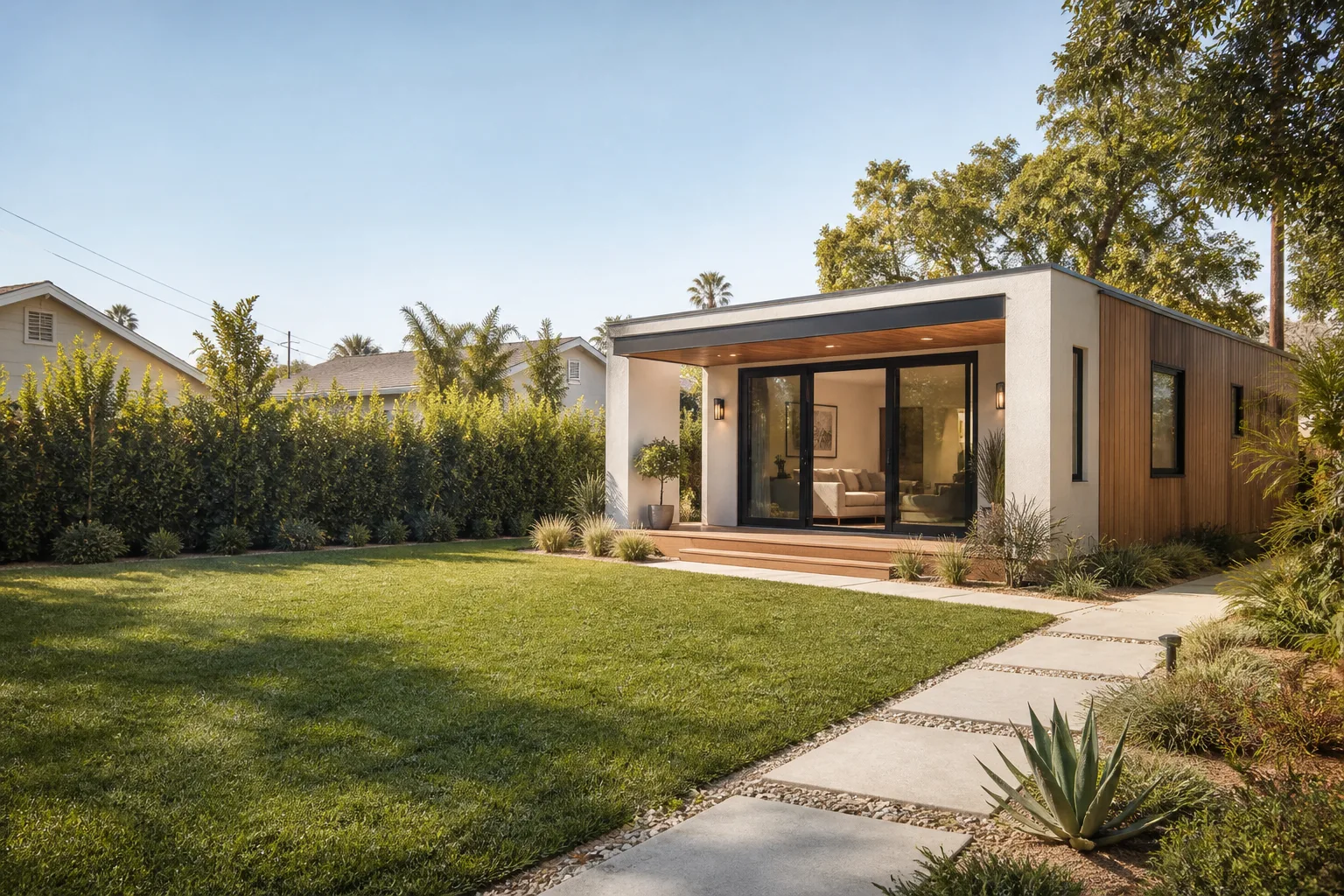
Most detached ADUs in Houston run $180,000 to $320,000 all-in for a 400 to 800 square foot unit in 2026, which works out to roughly $220 to $340 per square foot once permits, utility connections, site work, design fees, and financing costs are included. Garage conversions typically land between $90,000 and $160,000, while attached in-law suites range from $130,000 to $240,000 depending on whether you’re adding a kitchen and a separate meter. The single biggest budgeting mistake Houston homeowners make is comparing their finished, permitted, site-worked project against someone else’s materials-only starting price.
Table of Contents
- The Real Cost Per Square Foot in Houston: Why $150 is a Floor, Not a Budget
- Line-Item Cost Breakdown for Three ADU Types in Houston
- The Houston Utility Reality: CenterPoint, Water Meters, and HVAC Sizing
- How Flood-Zone Designation Changes Your ADU Budget
- The Six Hidden Cost Categories Every Houston ADU Estimate Leaves Out
- Financing Is a Construction Cost: What 10 Months of Interest Actually Adds
- The True Cost of a Cheap Estimate: How Vague Scope Becomes Change Orders
- Common Mistakes to Avoid
- When to Call a Professional
- Frequently Asked Questions
- The Bottom Line
The Real Cost Per Square Foot in Houston: Why $150 is a Floor, Not a Budget
Let’s start with what $150 per square foot actually buys you in Houston in 2026: a basic wood-framed structure with builder-grade finishes, on a flat lot that doesn’t require piers, with the electrical panel already sized correctly, and no kitchen appliances beyond the minimum. That’s it. No permits, no site grading, no utility taps, no design drawings, no landscaping restoration, no financing costs. It’s the number a prefab manufacturer quotes when you ask “what does the unit itself cost” and it’s an honest number. It’s also about 60 percent of what you’ll actually spend.
We’ve built ADUs in neighborhoods from Garden Oaks to Meyerland, and the per-square-foot math shifts block by block. A 600-square-foot detached cottage in the Heights might run $195,000 while an identical unit in Kingwood runs $215,000 because of longer material delivery routes and different soil conditions. Clay soil swells and shrinks with Houston’s rain patterns, which means deeper piers and more concrete than a sandy-soil lot in Galveston County. That’s not a contractor upcharge. That’s geology.
Here’s a more useful way to think about the number: for a permitted, connected, finished ADU in Houston in 2026, budget $220 to $280 per square foot for a garage conversion, $260 to $340 per square foot for a detached unit under 500 square feet, and $240 to $320 for an attached suite. The smaller the unit, the higher the per-square-foot cost, because you’re spreading fixed expenses like the electrical panel upgrade and the sewer tap over fewer square feet. A 400-square-foot ADU doesn’t cost half of an 800-square-foot one. It costs about 70 percent of it.
You’ll find the full ADU Builders in Houston cost picture is easier to navigate once you understand what’s fixed versus what scales. The slab costs what it costs whether the building on top of it is 400 or 700 square feet. Same with the water tap, the sewer connection, and the permit fees. Those fixed costs are why national per-square-foot averages mislead Houston homeowners so consistently.
Line-Item Cost Breakdown for Three ADU Types in Houston
The table below shows what we’re seeing in Houston in 2026 for three common ADU approaches. These ranges assume a standard lot with reasonable access, no flood-zone complications, and a panel that doesn’t need a full service upgrade. We’re showing the line items because this is the level of detail you should expect from any estimate you receive.
| Cost Category | Detached Cottage (400 sq ft) | Garage Conversion (450 sq ft) | Attached In-Law Suite (500 sq ft) |
|---|---|---|---|
| Design & Engineering | $6,000 – $12,000 | $3,500 – $7,000 | $5,000 – $10,000 |
| Permits & City Fees | $4,500 – $9,000 | $2,800 – $5,500 | $3,500 – $7,000 |
| Site Work & Foundation | $18,000 – $35,000 | $3,000 – $9,000 (IF slab exists) | $8,000 – $18,000 |
| Structure & Shell | $55,000 – $90,000 | $30,000 – $55,000 | $40,000 – $70,000 |
| Electrical (panel & wiring) | $8,000 – $16,000 | $7,000 – $14,000 | $7,000 – $13,000 |
| Plumbing (rough & finish) | $10,000 – $19,000 | $9,000 – $18,000 | $9,000 – $17,000 |
| Utility Connections & Taps | $5,000 – $12,000 | $3,000 – $8,000 | $3,500 – $9,000 |
| HVAC | $7,000 – $12,000 | $6,000 – $10,000 | $6,500 – $11,000 |
| Insulation & Drywall | $8,000 – $14,000 | $7,000 – $12,000 | $7,500 – $13,000 |
| Flooring, Cabinets, Fixtures | $20,000 – $40,000 | $18,000 – $35,000 | $22,000 – $42,000 |
| Painting & Finishes | $6,000 – $11,000 | $5,000 – $9,000 | $6,000 – $10,000 |
| Landscaping Restoration | $2,500 – $7,000 | $1,500 – $4,000 | $2,000 – $5,000 |
| Total Range | $180,000 – $320,000 | $90,000 – $160,000 | $130,000 – $240,000 |
When you compare these ranges side by side, you’ll notice something counterintuitive: the garage conversion appears cheapest, but it carries the most uncertainty. A 1950s or 1960s garage in Bellaire or Westbury was never built to code for living space, one of several ADU warning signs Houston homeowners should watch for. The slab may be 3 inches thick instead of the 4 to 6 inches residential code now requires. The roofline may not accommodate proper insulation depth. Electrical service to a garage is typically a single 20-amp circuit, nowhere near what a kitchen and mini-split require. Some Houston garage conversions end up costing more than a detached cottage because you’re fighting an existing structure rather than building clean.
If you’re weighing a conversion against new construction, an Home Addition Contractor in Houston can walk you through what your specific garage can and cannot support before you commit to the cheaper-looking path.
The Houston Utility Reality: CenterPoint, Water Meters, and HVAC Sizing
Houston’s utility landscape adds costs that national ADU guides never mention because they’re writing for a generic American city. You’re not in a generic city. You’re in a place where the electrical provider is CenterPoint Energy, the water utility is the City of Houston (or a MUD district if you’re outside city limits), and the climate demands an HVAC system that can handle 95-degree August afternoons with 80 percent humidity.
Let’s start with electrical. If your existing panel is 100 amps (common in homes built before 1990), an ADU with a kitchenette, a mini-split, and lights will almost certainly require a service upgrade to 200 amps. That’s $3,500 to $7,000 for the panel change itself, plus another $800 to $2,000 in CenterPoint fees depending on whether your service drop is overhead or underground. If your panel is already 200 amps and has spare breaker slots, count yourself lucky. But check the actual load calculation before assuming you’re fine. A 200-amp panel running a 5-ton central AC, an electric dryer, and a pool pump may not have the headroom for another living unit.
Water is its own Houston-specific minefield. A detached ADU with its own kitchen and bathroom requires a separate water meter if you want to bill a tenant separately or qualify for certain rental documentation. The City of Houston charges $2,500 to $5,000 for a new residential water tap, and that’s before the plumber’s connection work. MUD districts in areas like Cypress, Katy, and Sugar Land set their own tap fees, sometimes higher. If you’re on a septic system (common in rural pockets of Harris County and further out), a second living unit may trigger a system sizing review that costs $1,200 to $4,000 for the inspection and possible tank replacement.
And you cannot skip HVAC in Houston. This is not a climate where a window unit and a box fan count as a finished unit. A properly sized mini-split for a 400-square-foot ADU runs $7,000 to $12,000 installed, and you want it sized correctly the first time. Oversizing leads to short cycling, which leaves the unit unable to dehumidify properly, and in Houston, dehumidification matters as much as cooling. Mold is the silent cost of an underconditioned space, and mold remediation in a finished ADU starts around $3,000.
How Flood-Zone Designation Changes Your ADU Budget
Living in Houston means living with the reality of flood maps, and your ADU budget changes dramatically based on which zone your lot sits in. This is the cost category that national guides miss entirely, and it’s the one that can add $15,000 to $70,000 to your project overnight.
First, determine your flood zone. You can check FEMA’s map service or ask your builder to pull the designation. If your lot is in Zone X (unshaded), you’re outside the high-risk area and standard construction applies. If you’re in Zone AE or Zone AO (the 100-year floodplain), everything changes. An elevation certificate from a licensed surveyor costs $500 to $1,200, and you’ll need it before the city will even process your permit. The foundation requirements shift from a standard slab to either a pier-and-beam elevated design or a slab with flood vents, both of which add $10,000 to $30,000 to a 600-square-foot structure.
The insurance impact matters even more if you plan to rent the ADU. Flood insurance for a rental unit in Zone AE can run $1,800 to $4,500 annually depending on elevation and construction type. That’s a recurring cost that never shows up in a construction estimate but permanently affects your rental yield. A $2,000-per-month rental generating $24,000 in gross revenue looks very different when $3,500 disappears to flood insurance before you count property taxes, maintenance, and vacancy.
Even outside the formal floodplain, Houston’s drainage reality means smart site planning matters. We’ve watched homeowners in Meyerland and along Brays Bayou pour a slab at grade, only to discover that a 10-year rain event sends sheet flow across the backyard. A few thousand dollars of grading, French drains, and rain gardens at the start prevents $20,000 of water damage later. Houston soil is gumbo clay that expands and contracts with moisture, so proper drainage isn’t cosmetic. It’s structural.
The Six Hidden Cost Categories Every Houston ADU Estimate Leaves Out
The single biggest source of budget overruns in Houston ADU projects isn’t greed or bad faith. It’s omission. Contractors estimate what they can see: materials, labor, and their own profit. They leave out categories that fall outside the construction contract, either because they assume the homeowner knows about them or because including them makes the bid look expensive next to a competitor’s leaner number. Here’s what actually gets left out, in the order of how often we see it blow up budgets.
- Permits and plan review fees. The City of Houston charges plan review fees, building permit fees, and inspection fees that typically total $4,000 to $9,000 for a detached ADU. If you’re in a historic district like the Heights or East End, add design review and possible variance hearings.
- Utility connection charges. Covered in detail above, but worth repeating: new electrical service, water tap, and sewer connection routinely total $6,000 to $14,000 combined. No contractor’s materials estimate includes the utility company’s own fees.
- Site preparation. Tree removal ($800 to $3,500 per tree in Houston), demolition of existing structures, grading after heavy rains, and haul-off of construction debris. Houston’s clay soil means you may need to over-excavate and backfill with select fill, adding $4,000 to $9,000 before concrete is even poured.
- Design and engineering fees. Depending on whether you use a design-build firm, an architect, or a prefab company’s in-house team, expect $6,000 to $15,000 for stamped drawings, structural calculations, and Title 24-style energy compliance documentation.
- Financing carry costs. A construction loan on $180,000 at current 2026 rates (roughly 7.5 to 9 percent for ADU construction) costs $11,250 to $13,500 in interest over a 10-month build. That’s a real line item. It rarely appears in any estimate you’ll receive.
- Landscaping and fence restoration. The mini-excavator that digs your foundation trench doesn’t tiptoe. Count on $2,500 to $7,000 to repair the backyard, and more if you’re replacing a fence section the crew removed for access.
When we deliver a written price to a Houston homeowner, these categories are in the line items. Our price is the price because the scope includes the predictable work. If you walk into this process knowing these six categories exist, you’ll ask better questions of every builder you interview.
Financing Is a Construction Cost: What 10 Months of Interest Actually Adds
Most Houston homeowners finance their ADU with a construction loan, a HELOC, or a cash-out refinance. Here’s what almost nobody tells you: the interest you pay during the build is a construction cost, not a financing cost. It should be in your project budget next to the roofing and the drywall. Here’s the math.
Say you’re building an $180,000 detached ADU. You take a construction loan at 8 percent (a reasonable 2026 rate for residential construction). Construction loans are interest-only during the draw period, calculated on the amount actually disbursed, not the full commitment. If the project takes 10 months and the draws are spread roughly evenly, your average outstanding balance is around $90,000. Interest on $90,000 at 8 percent for 10 months is $6,000. At 9 percent, it’s $6,750. That’s real money, and it’s money that buys you nothing but time.
Now, add the three-week permitting delay. Add the two weeks of rain that stops foundation work in a Houston spring. Add the CenterPoint scheduling lag for the electrical connection. A 10-month project becomes an 11.5-month project, and the interest meter keeps running. This is why schedule discipline matters financially, not just emotionally. A builder who can’t give you a credible timeline isn’t just inconveniencing you. They’re costing you interest every week.
The $150-per-square-foot conversation ignores all of this. That number assumes the project exists in a world where money is free and time is infinite. Houston isn’t that world. When you’re comparing builders, ask when the first draw happens, how draws are scheduled against the completion of phases, and what their realistic timeline is for a project your size in your specific neighborhood.
The True Cost of a Cheap Estimate: How Vague Scope Becomes Change Orders
Here’s how the $120,000 estimate becomes a $178,000 invoice. The contractor writes a bid with these line items: “Framing: $38,000. Rough plumbing: $12,000. Electrical: $9,000. Fixtures: Allowance.” The word “allowance” is where the money hides. An allowance is a placeholder, a guess spelled in a way that sounds official. When the real number comes in, it comes as a change order, and change orders are how vague estimates quietly double.
We’ve analyzed change-order patterns on Houston ADU projects, and the averages are consistent. Projects with detailed, line-itemed contracts average 4 to 7 percent in change-order costs. Projects with vague contracts average 15 to 22 percent. On a $150,000 ADU, that’s the difference between $6,000 of surprises and $33,000 of them. The vague contract doesn’t save you money. It just delays when you find out the real price.
Common change-order triggers include: kitchen appliance allowances set at $2,000 when any functional range, hood, and refrigerator set costs $4,500 to $8,000; flooring allowances that cover builder-grade vinyl but not the luxury vinyl plank you thought you’d agreed to; electrical that covers the panel connection but not the trenching from the panel to the ADU; and HVAC that includes the unit but not the pad, the line set cover, or the thermostat wiring. Each of these sounds minor. Together they’re $15,000 to $30,000.
This is why the written price before work starts matters so much. If you can’t review a line item, you can’t approve it, and if you can’t approve it, you shouldn’t be paying for it. The Room Addition Contractor in Houston approach we practice is straightforward: every line item is written, every allowance is a real number, and the price we show you before the first tool arrives is the price you pay unless you change the scope yourself.
Prefab vs. Site-Built: What the Unit Cost Doesn’t Include
Houston homeowners are increasingly asking about prefab ADUs from companies like Boxabl, Plant Prefab, and Tuff Shed conversions, and we’re glad they’re asking. A prefab unit can absolutely make sense here, but the national marketing around these products creates the same problem as the $150-per-square-foot number: it quotes the factory price, not the delivered-and-connected price.
A Boxabl or Plant Prefab unit might cost $80,000 to $140,000 for the module itself. What’s not included: shipping to Houston from the factory (often $3,000 to $8,000 depending on origin), crane rental for the set ($2,500 to $6,000), site prep and foundation (same as any other build), utility connections (same as any other build), and assembly labor. We’ve seen all-in costs for a prefab ADU in Houston land within 10 percent of a site-built unit of the same size, sometimes higher once you factor in the crane and the shipping.
Where prefab genuinely wins is schedule. A factory-built module can cut 6 to 10 weeks off the construction timeline, which reduces the financing cost we discussed earlier. If you’re weighing options, talk to a builder who has actually worked with the specific brand you’re considering. We’ve installed James Hardie cladding systems on site-built ADUs and managed Tuff Shed conversions, and we’ll tell you honestly when a prefab path makes sense and when it doesn’t. The right answer depends on your lot, your access, and your timeline, not on a brochure.
Common Mistakes to Avoid
- Budgeting at $150 per square foot. That number excludes the six cost categories detailed above. Budget at $220 to $340 per square foot all-in for Houston, and you’ll be in the right range.
- Skipping the flood zone check. Houston lots that look dry can still sit in a mapped floodplain. The $500 elevation certificate is the cheapest insurance you’ll ever buy against a $30,000 foundation surprise.
- Ignoring the electrical panel capacity. A 100-amp panel can’t support an ADU without an upgrade. The $5,000 to $9,000 panel change is predictable. Find out the day of your first walkthrough, not the week before drywall.
- Accepting allowances instead of real numbers. An allowance is a polite way to underbid a project. Ask every builder to convert every allowance to a specified product with a written price before you sign.
- Not modeling financing costs. Interest during construction is a real line item. Add $6,000 to $10,000 to your budget for a financed Houston ADU, and ask about the construction timeline before you commit.
- Choosing the lowest bid without comparing line items. Houston has hundreds of contractors. The bid that’s $40,000 cheaper is usually cheaper because it’s missing categories, not because the builder found a magic way to buy lumber at a discount.
- Underestimating HVAC. In Houston’s climate, a properly sized mini-split is not optional, and undersizing it creates mold problems that dwarf the original cost. Size for August, not for March.
When to Call a Professional
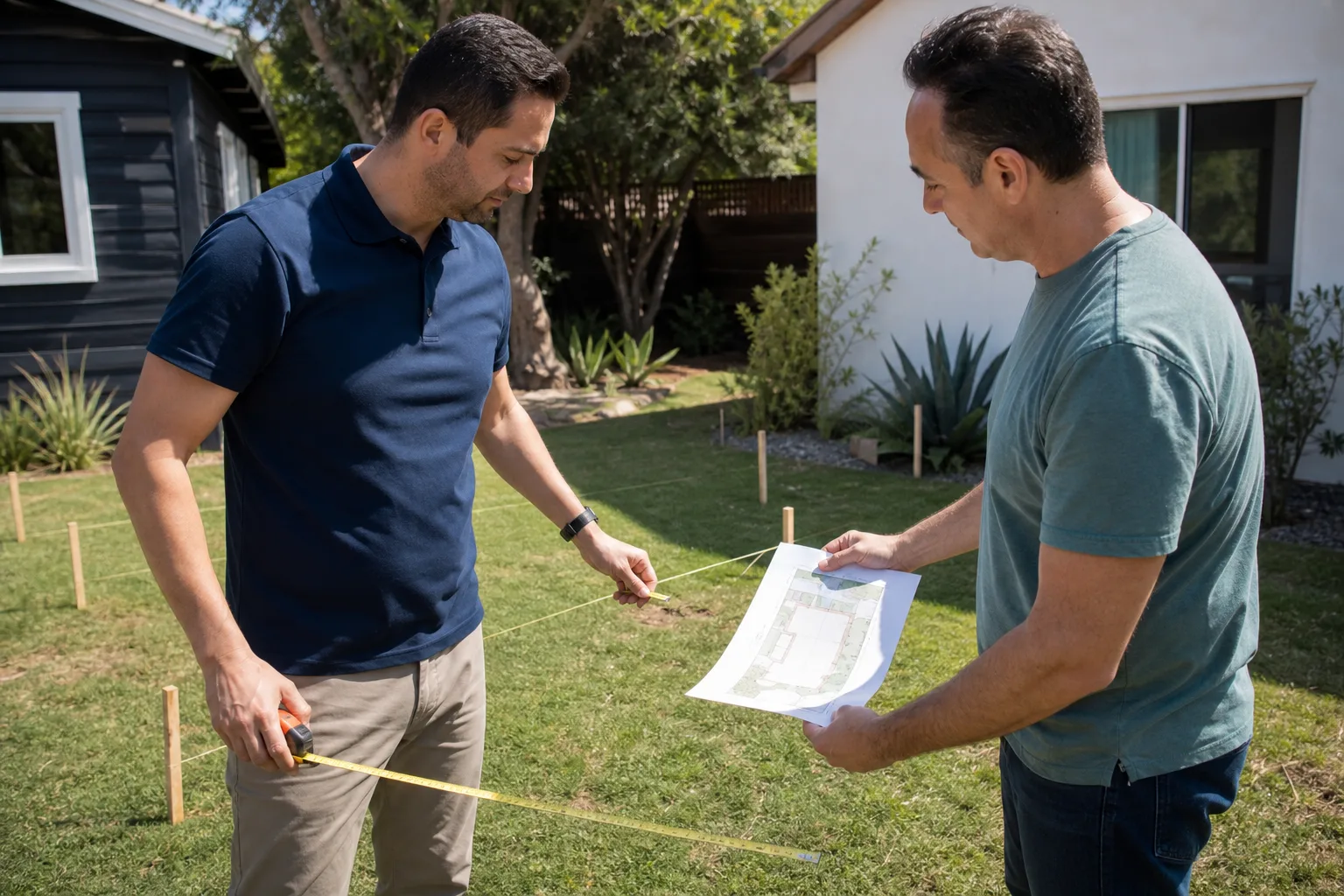
You should involve an ADU professional before you spend money on land surveys, soil tests, or architectural drawings. The right builder can tell you in the first conversation whether your lot, your panel, and your budget are actually compatible with your vision. If you’re in a flood zone, if your home was built before 1990, if you have a septic system, or if you’re considering a prefab unit, you need someone who has navigated these Houston-specific complications before. Sutton ADU Houston offers free estimates throughout Houston, and we’ll walk your property, check your panel, look at your access, and give you a written price before any work starts. Call (940) 242-3207 to schedule yours. No pressure, no vague allowances, no surprises.
Frequently Asked Questions
Most Houston ADUs cost $180,000 to $320,000 all-in for a 400 to 800 square foot detached unit, $90,000 to $160,000 for a garage conversion, and $130,000 to $240,000 for an attached in-law suite. That includes permits, utility connections, site work, design, and all finishes, not just the structure itself. Call (940) 242-3207 for an exact quote based on your lot and scope.
The only ADU approach in Houston that can consistently come in under $100,000 is a garage conversion on a property with an existing 200-amp panel and no flood-zone complications, and even then you’re looking at $90,000 to $100,000 for a modest finished unit. A new detached ADU under $100,000 usually means cutting corners that Houston’s climate and code will not forgive. A Tuff Shed shell with finished interior can approach that number, but it rarely includes the utility connections that make the unit legal to rent.
Three factors drive the variation: soil conditions (clay in most of Houston requires deeper piers, while sandier areas are cheaper to build on), flood zone status (Zone AE foundations cost $10,000 to $30,000 more), and distance from utility infrastructure (longer electrical drops and water mains mean higher connection fees). A 600-square-foot ADU in the Heights may cost $195,000 while the same unit in Kingwood runs $215,000, and both prices are legitimate.
It usually costs less upfront ($90,000 to $160,000 versus $180,000 to $320,000), but existing garage slabs from the 1950s and 1960s often fail current residential code requirements for thickness and reinforcement, which can drive costs up unexpectedly. You’re also constrained by the existing footprint, roofline, and wall framing, which limits design flexibility. Some Houston garage conversions end up costing nearly as much as a new build once structural remediation is included.
The City of Houston requires stamped architectural drawings, a site plan showing setbacks (the required gap between your new structure and the property line), an energy compliance calculation, and structural engineering for the foundation, all covered in our guide to ADU permits, codes & inspections in TX. Permit and plan review fees typically total $4,000 to $9,000 for a detached ADU, and historic districts like the Heights add design review on top. The process typically takes 6 to 12 weeks from submission to approval.
At Sutton ADU Houston, no. Your written price includes every line item on the agreed scope, and you receive it before any work begins. For more guides & resources on planning your project, explore our blog. The 365-Day Done Right Promise covers defects in workmanship for one full calendar year from project completion, with a free second visit if any element fails. Change orders only occur if you expand the scope yourself, and each one comes with a written price before the work proceeds.
The Bottom Line
A Houston ADU is not a $150-per-square-foot project. It’s a $220 to $340 per-square-foot project once you account for permits, utility taps, site work, design fees, financing carry costs, flood-zone realities, and landscaping restoration. The good news is that every one of those costs is predictable if you know to ask about them. Demand a line-itemed written price with no allowances, check your flood zone and panel capacity in the first week, and model the interest cost of the construction timeline. Then you’ll know your real number, and you can decide with confidence whether a backyard cottage, a garage apartment, or an attached suite is right for your Houston lot. We’ve been building in Houston since 2006, and we’re happy to walk your property and give you a straight answer at no cost. Call (940) 242-3207 to schedule your free estimate.
Written by Miles Hartwell, Owner at Sutton ADU Houston, serving Houston since 2006.